For Organizations
Customize your Copilot
Build your own
Most enterprises did not decide to deploy agents.
They decided to deploy Copilot. Then Power Platform. Then a few "smart workflows." Then a few teams started building their own.
By the time IT counted, there were dozens running in production.
And no single place to see them.
That is the problem Agent 365 launches into on May 1, 2026.
Agent 365 is not a new agent.
It is a control plane.
It does one thing the rest of the Microsoft AI stack does not:
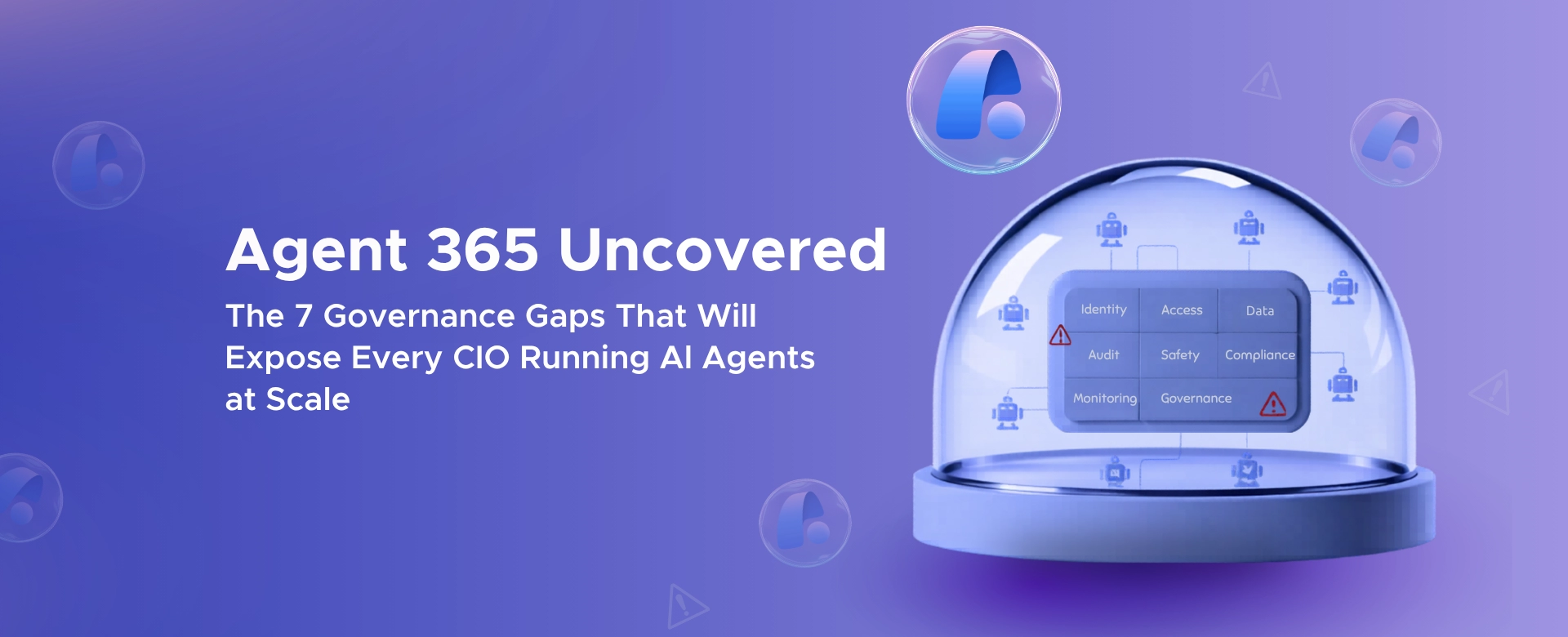
give IT a single place to discover, govern, secure, and retire every AI agent in the tenant
regardless of who built it, where it runs, or which framework it uses
For most CIOs, the first week of Agent 365 will not feel like a deployment.
It will feel like an audit.
These gaps already exist in most enterprises running agents at any meaningful scale.
Agent 365 does not create them.
It just makes them visible.
Every organization assumes it has "a few" custom agents.
Most have many more.
Built in Copilot Studio, Power Platform, third‑party frameworks, or a developer's local environment. Never inventoried. Never reviewed.
Agent 365's registry will discover them. The number is almost always higher than leadership expects.
Agents are built by individuals.
Individuals change roles, leave, or stop maintaining what they built.
The agent keeps running. It keeps consuming data. It keeps acting on behalf of users.
Nobody is accountable for it.
Agent 365 will flag these. The conversation that follows is rarely comfortable.
Agents act on behalf of users.
But the access surface is rarely as tight as the user's own.
Connections get reused. Tokens get over‑scoped. Tools get granted "just in case."
Least‑privilege exists in policy, not in practice.
Agent 365 makes the gap visible. Which means it also makes it auditable.
Most enterprises have a clean offboarding process for employees.
Almost none have one for agents.
There is no equivalent of a quarterly access review. No mandatory expiry. No inactivity policy.
Agents accumulate. Drift accumulates with them.
Agent 365 introduces lifecycle rules. That forces a question very few organizations have answered.
Who decides when an agent is retired?
Single‑agent workflows are easy to reason about.
Multi‑agent ones are not.
When Agent A calls Agent B which calls a third‑party agent which writes to SharePoint, the audit trail fragments quickly.
Most existing logging is built for users, not chains of non‑human actors.
This gap does not show up in pilots. It shows up the first time something goes wrong in production.
Most CIOs already know they have a SharePoint oversharing problem.
Agents make it sharper.
An agent does not browse. It queries, summarizes, and surfaces, often across libraries a human would never have visited.
Anything overshared becomes immediately reachable.
Purview integration in Agent 365 will expose this clearly. The remediation work usually sits with information governance, not the AI team.
Conditional access was designed for humans logging in from devices.
Agents are neither.
They act continuously. Often headlessly. Sometimes across tenants.
Prompt injection, tool abuse, and adversarial inputs change the threat model.
Extending Entra conditional access to agents is necessary. It also reveals how much of the existing identity posture was built around assumptions that no longer hold.
For some organizations, Agent 365 is the right call on day one.
It fits best when:
In those environments, Agent 365 consolidates a problem that was becoming hard to govern.
For others, Agent 365 will be early.
It is usually a stretch when:
In those cases, the right move is not to delay Agent 365.
It is to prepare for what it will reveal.
Agent 365 is a useful product.
But the value it delivers is mostly diagnostic.
It tells you what is already true about your environment.
Whether that becomes a strategic advantage or an uncomfortable surprise depends entirely on how prepared the organization is to act on what it sees.
The organizations that will handle this well are treating May 1 not as a product launch.
They are treating it as a governance milestone.
The same way identity became a milestone a decade ago. The same way data did five years ago.
If you are evaluating Agent 365 today, the more valuable question is not "should we adopt it?"
It is "are we ready to be honest about what it will show us?"
That question usually leads to better governance, and far fewer surprises.
If you are a CIO, CISO, or technology leader preparing for Agent 365 and you are seeing:
it may be worth running a structured Agent 365 readiness assessment before May 1, not after.
I work with organizations to:
Feel free to contact us.