Penthara-Logo-Dark
For Organizations

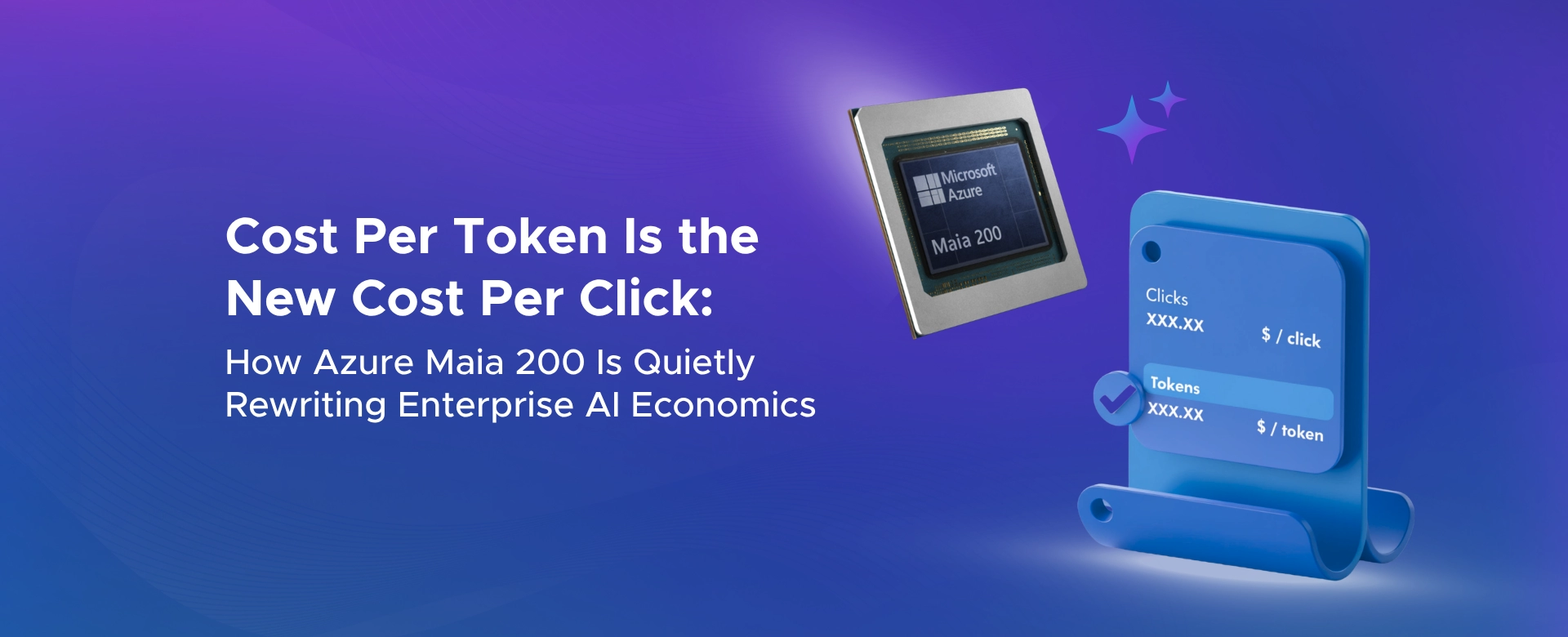
Cost Per Token Is the New Cost Per Click: How Azure Maia 200 Is Quietly Rewriting Enterprise AI Economics

Cost per token is replacing cost per click. Azure Maia 200 quietly cuts AI inference costs, giving predictable, CFO-ready AI economics.

For most of the last decade, cloud conversations were about spend per hour.

Now, AI has changed the unit entirely.

Tokens are the new currency.

Every prompt.
Every response.
Every retry.

And suddenly, CFOs are asking questions that sound very familiar: “How much does this action cost?” “What happens when usage scales?” “Where is the margin going?”

This is where Azure Maia 200 enters the picture.

Quietly.
Deliberately.
Without much marketing noise.

Why the conversation has shifted to unit economics

AI spend behaves differently from classic cloud workloads.

You don’t buy capacity and fill it gradually.
You generate cost every time a model thinks.

That makes cost per token the number that matters.

Two applications with the same number of users can have radically different AI bills depending on:

  • prompt size
  • model choice
  • response length
  • retries and orchestration patterns

Finance teams understand this problem instantly.

It’s the same shift digital marketing went through years ago when cost per click replaced impressions. When spend became dynamic, measurement mattered more than raw scale.

AI is now going through the same transition.

What Maia 200 actually changes

Azure Maia 200 is not about training bigger models.

It’s about running models cheaper, faster, and more predictably once they are in production.

Microsoft designed Maia 200 specifically for inference, the part of AI workloads that dominates cost once adoption moves past experimentation.

The result is a materially better performance‑per‑dollar profile compared to previous Azure hardware. Roughly thirty percent better by Microsoft’s own measurements.

That improvement flows directly into token economics.

Lower infrastructure cost per token means:

  • lower run‑rate costs
  • more predictable forecasting
  • better margins on AI‑powered features

This is not abstract efficiency. It shows up directly on invoices.

Why this matters to CFOs more than model accuracy

Accuracy improvements are hard to quantify financially.

Token costs are not.

When AI workloads scale, a few cents per thousand tokens compounds into millions per year. Especially in industries like financial services, insurance, and customer support where:

  • volume is high
  • interactions are frequent
  • response length is non‑trivial

For finance leaders, Maia 200 changes the slope of that curve.

The conversation moves from “AI is powerful but expensive” to “AI cost can actually be managed.”

That’s a meaningful shift.

The BFSI lens: where this hits first

Banks and insurers feel this pressure earlier than most.

They run high‑volume workloads:

  • document analysis
  • customer interactions
  • risk scoring
  • internal copilots for frontline staff

These aren’t novelty use cases. They are operational systems.

In those environments, token efficiency is not optimization. It’s table stakes.

A thirty percent improvement in performance per dollar is effectively a thirty percent improvement in economics, without touching the application layer.

That’s why Maia 200 is more interesting to CFOs than to data scientists.

This isn’t just a hardware story

The bigger signal is Microsoft’s intent.

Maia 200 is part of a broader shift where hyperscalers are taking control of AI cost structures instead of passing volatility directly to customers.

Custom silicon lets Microsoft:

  • stabilize pricing curves
  • protect margins
  • offer enterprises more predictable AI economics

This is how cloud providers defend profitability as AI becomes core infrastructure rather than an add‑on.

What this means for enterprise AI strategy

For CIOs and CFOs, the implication is simple.

AI cost management is no longer just a FinOps extension.
It’s becoming a first‑class planning discipline.

Model choice matters.
Prompt design matters.
Infrastructure matters.

And increasingly, the cloud platform you choose determines how painful or manageable that cost curve becomes.

Maia 200 does not eliminate AI cost risk.
But it lowers it materially.

The executive reality

AI spend is moving from experimental budgets to operating budgets. 

Once that happens, the conversation changes. 

Leaders stop asking “What can this model do?” They start asking “What does this cost at scale?” 

Cost per token is becoming the number that anchors that discussion. 

Azure Maia 200 doesn’t make headlines like a new model release. But it quietly changes the economics underneath everything that runs on Azure AI. 

And in enterprise environments, that’s where longterm decisions are actually made. 

Let’s connect

If you’re a CFO, CIO, or technology leader wrestling with: 

  • unpredictable AI run rates 
  • difficulty forecasting token spend 
  • pressure to scale AI without blowing margins 

this shift is worth paying attention to. 

I work with organizations to: 

  • translate AI usage into CFOgrade unit economics 
  • design FinOps models that make token spend governable 
  • align AI infrastructure choices with longterm cost control 

Feel free to contact us.

Written & Reviewed by

Jasjit Chopra

Chief Executive Officer
Comment Now

Leave a Reply

Your email address will not be published. Required fields are marked *

More from this Category
How Companies are using Azure OpenAi to innovate and save time blog header image
Azure AI

How Companies are using Azure OpenAI to innovate and save time?

How companies use Azure OpenAI to automate tasks, boost productivity, enhance customer support, and drive innovation - securely and at...

Azure AI

Azure AI Can Solve Repetitive Work Teams Quietly Accept as “Normal”

Azure AI quietly eliminates repetitive, manual work teams accept as normal - freeing time, reducing errors, and boosting operational efficiency...

Azure AI

Most Azure AI Projects Are Built Like Pilots, Not Production Systems

Most Azure AI projects stop at pilot success. This article explains why production fails - and what it truly takes...

crossmenuchevron-down