Most Azure AI Projects Are Built Like Pilots, Not Production Systems
Most Azure AI projects stop at pilot success. This article explains why production fails - and what it truly takes...

In many AI discussions, size quietly becomes the substitute for thinking.
A bigger model. A more powerful endpoint. A reassuring sense that “we’re using the best.”
That mindset works in research settings.
It often breaks down in enterprise environments.
Because most enterprise problems are not vague, creative, or open‑ended. They are operational, repeatable, and tightly constrained.
Using the largest model by default often increases cost and complexity without improving outcomes.
Many teams treat AI as a single decision.
If we are doing AI, we should use the most capable model available.
But Azure AI is not built around one “best” model. It is deliberately broad. Lightweight classifiers, document intelligence, traditional ML, and large generative models all exist for different reasons.
The mistake is assuming those differences don’t matter.
They do.
A large portion of enterprise AI workloads revolve around the same types of tasks.
Documents being classified. Requests being routed. Fields being extracted. Content being tagged. Decisions being applied based on policy.
In these cases, variability is not a feature. It is a risk.
Large models introduce probabilistic behavior where predictability is often more important. Smaller or task‑specific models tend to perform better simply because they do the same thing every time.
Invoices, forms, claims, and contracts are good examples.
Once structure is known, the work becomes repetitive. Extract the same fields. Validate the same patterns. Push the same outputs downstream.
Large models do not add much value here. In many cases, they make behavior harder to reason about and harder to audit.
Purpose‑built extraction and classification pipelines are often more stable, easier to tune, easier to govern, and easier to operate at scale.
The goal is reliable output, not expressive language.
In regulated or operational systems, many decisions are bound by rules.
Eligibility criteria. Thresholds. Approval logic. Compliance constraints.
When decisions have to be explained later, probabilistic reasoning becomes uncomfortable very quickly.
In these environments, the smallest model that produces consistent results is usually the safest choice. This is not a technical limitation. It is a governance requirement.
Large models absolutely have a place in the enterprise.
They earn it when the output is consumed by humans and ambiguity cannot be avoided.
Summarizing large volumes of unstructured information. Synthesizing insights across documents. Supporting research and analysis. Powering conversational interfaces.
In these scenarios, interpretation matters more than repeatability. A human is expected to apply judgment.
That distinction is usually the deciding factor.
The cost of choosing a large model is not limited to usage charges.
Larger models tend to increase latency expectations, fallback logic, monitoring complexity, governance surface area, and operational fragility.
Over time, these systems become harder to trust, not easier.
Teams often discover that a simpler model delivers better outcomes simply because it survives production unchanged.
As model complexity increases, it becomes harder to answer basic questions leadership and risk teams care about.
Why did the system do this? How is its behavior constrained? What changes over time? How do we prove consistency?
Selecting a smaller, task‑fit model reduces these questions dramatically.
Enterprise AI success does not come from deploying the most powerful model available.
It comes from deploying the most appropriate model, with the least operational risk, and the clearest governance boundary.
Oversized models impress in demos. Right‑sized models hold up in production.
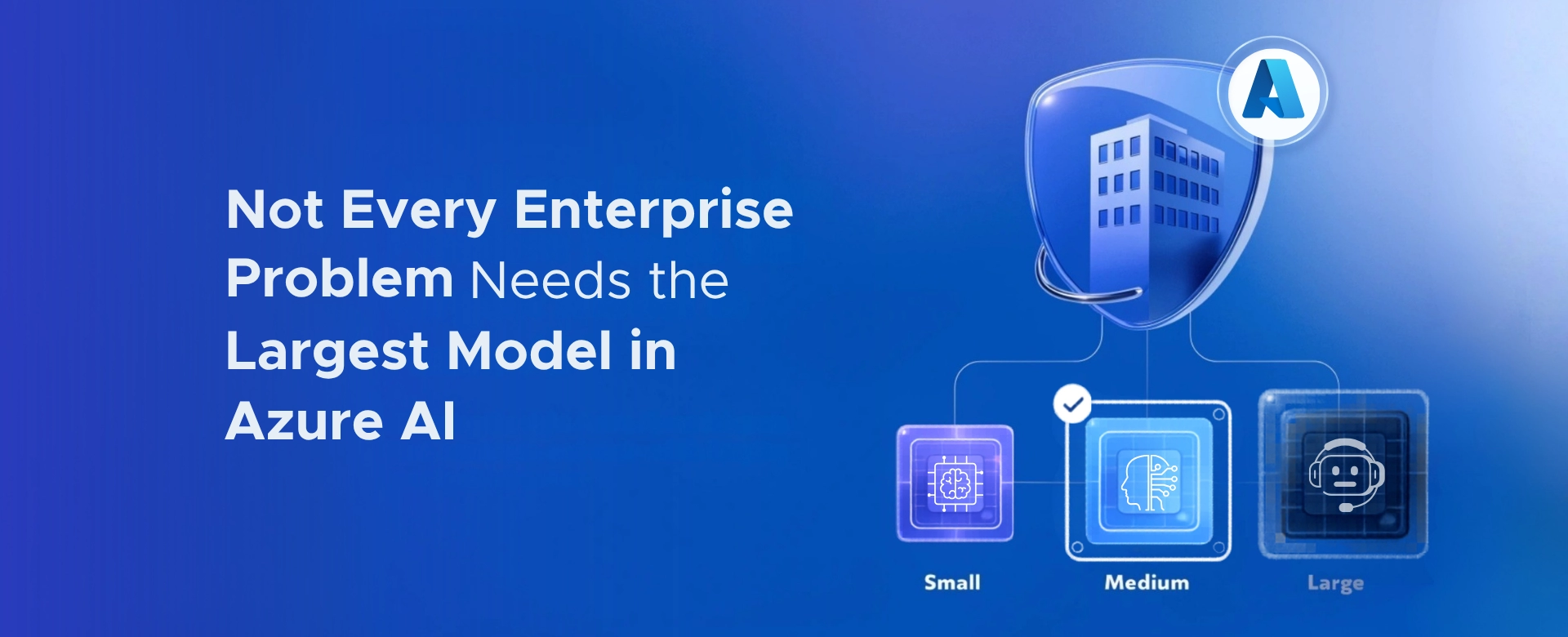
If you are evaluating Azure AI today, the more valuable question is not “what’s the biggest model we can use?”
It’s “what’s the smallest model that reliably does the job?”
That question usually leads to better systems and better outcomes.
If you’re a CXO, architect, or technology leader navigating Azure AI decisions and you’re seeing:
it may be worth rethinking model selection from a task‑fit perspective.
I work with organizations to:
Feel free to contact us.
Most Azure AI projects stop at pilot success. This article explains why production fails - and what it truly takes...
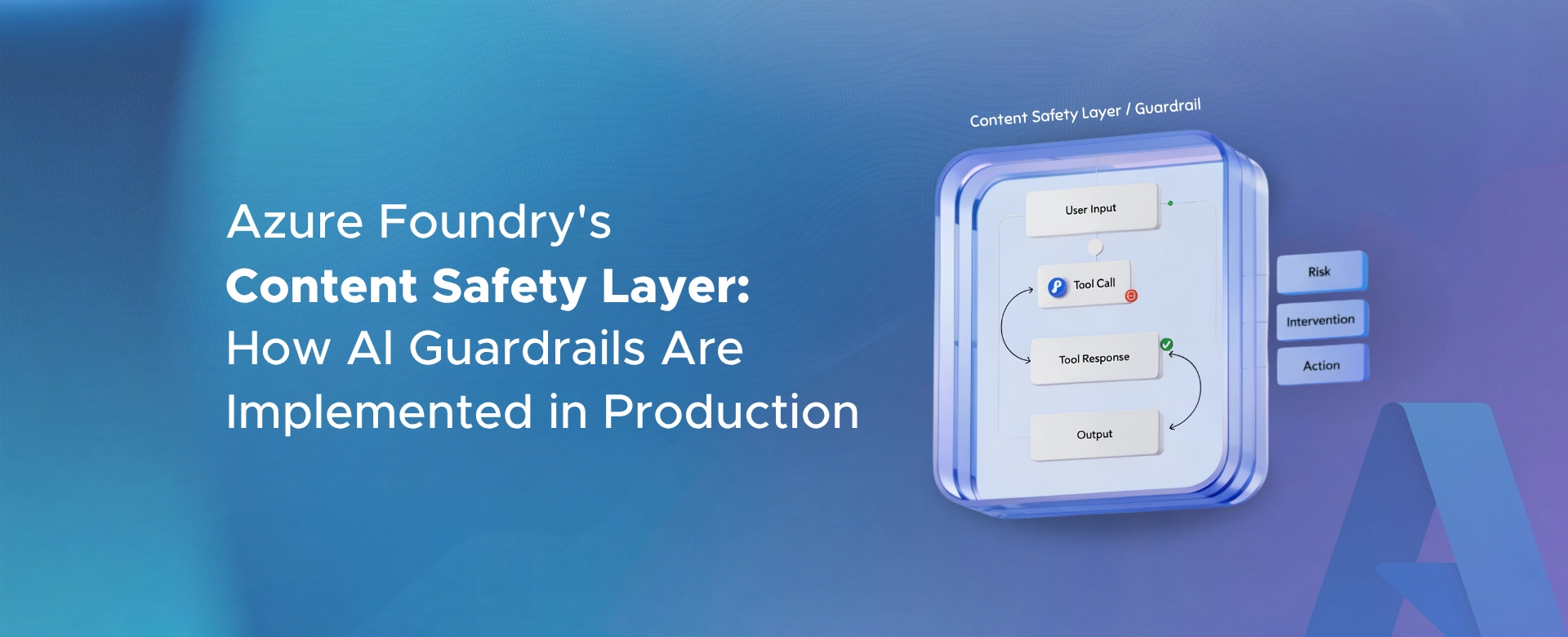
Azure Foundry’s safety layer uses multi-point guardrails - input, output, and prompt protection - to control risk and secure AI...
In regulated industries, AI can’t be a side experiment. Governance, accountability, and control must be built in from day one...