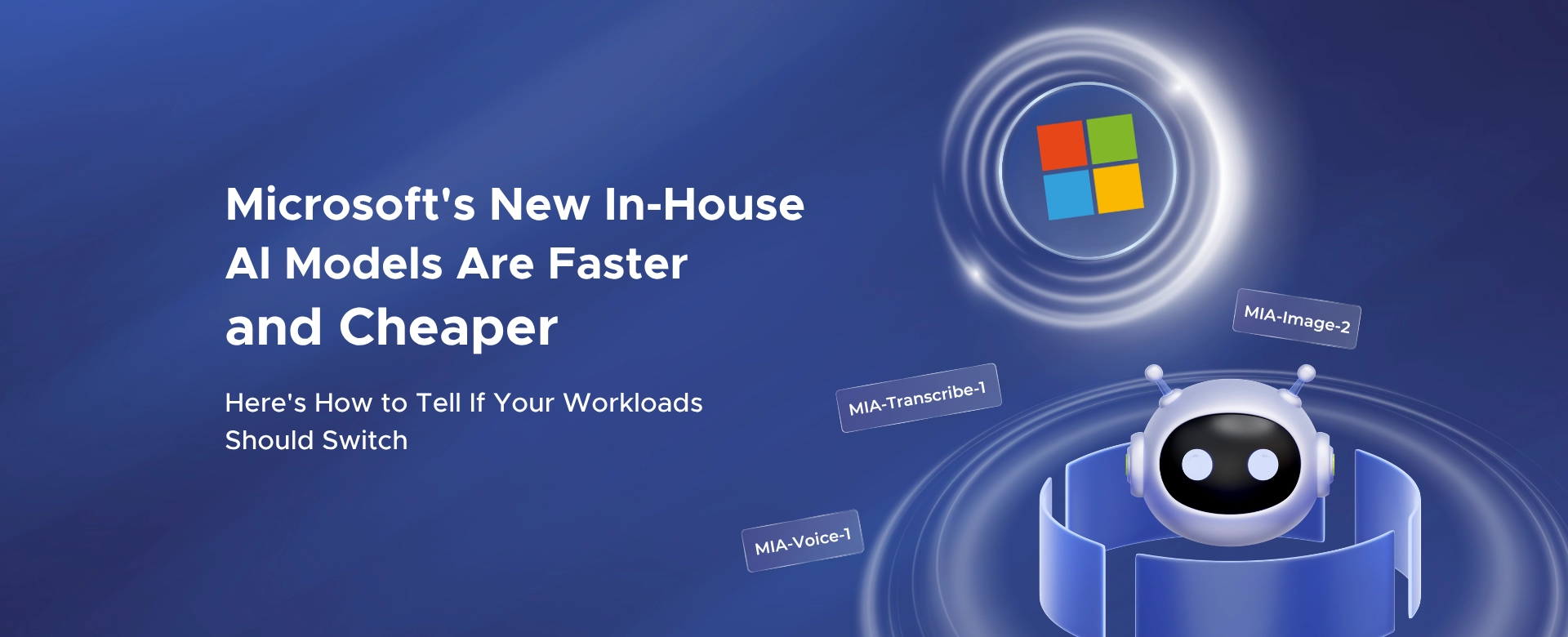
Microsoft’s New In House AI Models Are Faster and Cheaper
Microsoft launches faster, lower-cost in-house AI models, strengthening independence from OpenAI while boosting enterprise productivity and innovation.


Most “on‑prem AI” conversations still end in the same place.
A cloud endpoint. A VPN. A compliance exception. Or a pilot that never scales.
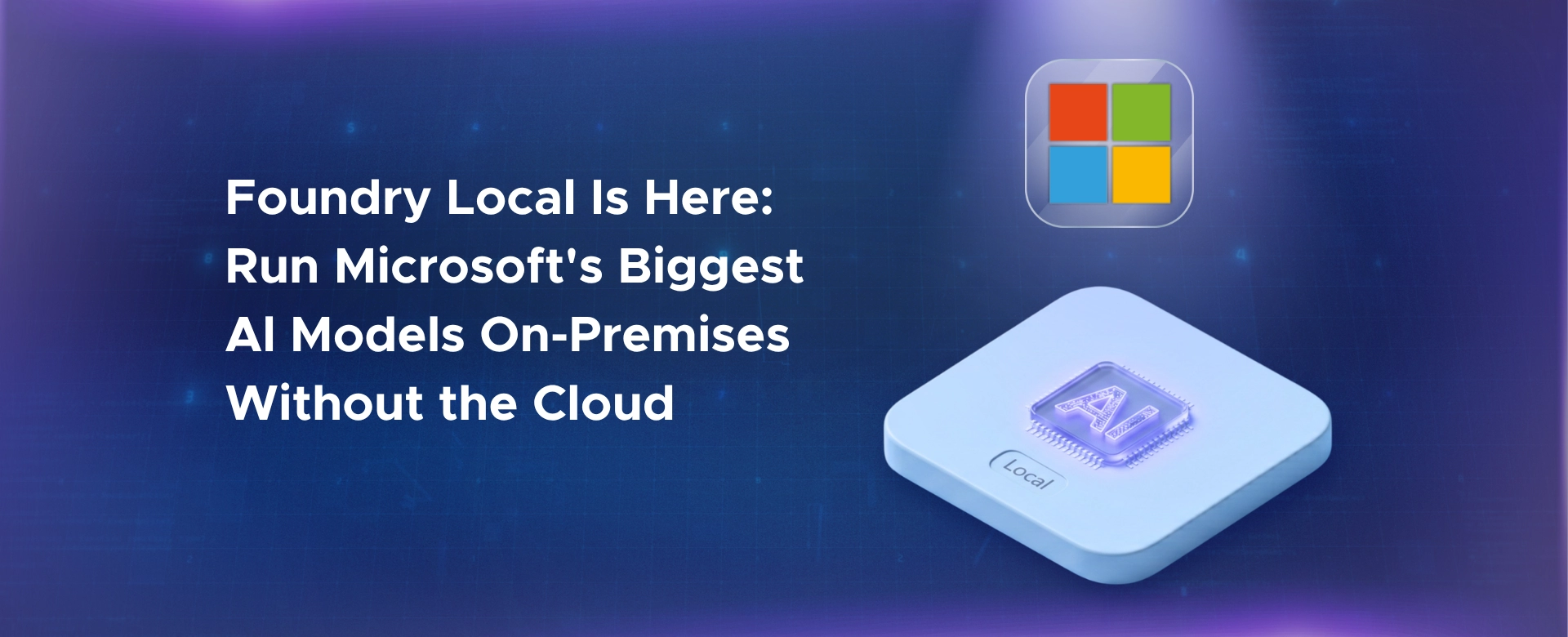
Foundry Local changes that.
It lets you run AI models entirely on your own device or server. No cloud dependency. No Azure subscription required.
But here’s the important correction upfront.
Foundry Local is not “run the biggest frontier models on a laptop.” It’s “ship production‑grade local inference in an enterprise way.”
That distinction matters.
Foundry Local is a local AI runtime plus SDK.
You download a model. It runs on your hardware. Inference happens locally.
It is positioned as “build once, run locally” with hardware‑optimized on‑device inference.
It also exposes an OpenAI‑compatible API, so many existing tools can integrate with minimal changes.
This is what Foundry Local unlocks for real enterprise teams.
Your data stays local. No prompts leaving your boundary.
Latency improves because there’s no network round trip.
And cost becomes predictable because there are no per‑token cloud charges, no API keys, and no inference backend to maintain.
For regulated industries or air‑gapped environments, that’s not a convenience.
That’s the difference between “allowed” and “not allowed.”
The hard part of local AI is hardware chaos.
Different GPUs. Different drivers. Different execution runtimes.
Foundry Local handles that by sitting on top of ONNX Runtime and managing execution providers.
It can detect available hardware and select the best acceleration path automatically, falling back to CPU when needed.
That matters because it reduces “local AI” from a science project to a deployable pattern.
Foundry Local is built around a curated model catalog that includes chat models and speech models, with heavy optimization for local inference.
It supports families like:
Phi Qwen Mistral DeepSeek GPT‑OSS and speech models like Whisper
This is important because it signals intent.
Foundry Local is not “one model.” It’s a local inference platform.
Foundry Local is not only for developer laptops.
Teams are already deploying it in disconnected environments using an offline pattern:
Stage on a connected machine. Download models and installer. Move model cache across the air gap. Run locally on the disconnected host.
That’s a real operational pattern.
And it fits environments that cloud AI struggles with:
Defense Government Critical infrastructure Remote edge
This is where expectations need to be set correctly.
Foundry Local does not magically turn your on‑prem server into a hyperscale model cluster.
Local inference is constrained by:
Your RAM Your GPU or NPU Your storage Your thermal envelope
Foundry Local solves the platform layer. It does not remove physics.
So the smarter mental model is simple.
Use local inference for privacy‑sensitive, latency‑sensitive, or offline workloads. Use cloud inference when you need frontier scale and elasticity.
If you want to know whether this matters for your organization, look for these patterns.
You have sensitive data that cannot leave your boundary. You need predictable latency for interactive apps. You need offline capability. You want to eliminate per‑token cost from certain workflows. You want an OpenAI‑compatible local endpoint for faster integration.
That combination is exactly what many enterprises are looking for right now.
Foundry Local is not a feature.
It’s a deployment option that changes governance.
Because once inference is local:
Data residency becomes easier. Audit boundaries become cleaner. Cost control becomes more predictable.
And it opens up environments that cloud AI simply cannot reach.
This is why Foundry Local matters.
Not because it’s flashy.
Because it makes “run AI inside your boundary” practical.
If you’re evaluating on‑prem AI for:
Regulated workloads Air‑gapped environments Edge deployments Or cost‑sensitive inference
Foundry Local is worth a serious look.
I help organizations decide:
What should run locally. What should remain in the cloud. And how to design governance around both.
Feel free to contact us.
Microsoft launches faster, lower-cost in-house AI models, strengthening independence from OpenAI while boosting enterprise productivity and innovation.