5-Point Copilot Readiness Checklist for Microsoft 365
Learn how to prepare your organization for Microsoft 365 Copilot by aligning strategy, cleaning up data, securing access, training users,...

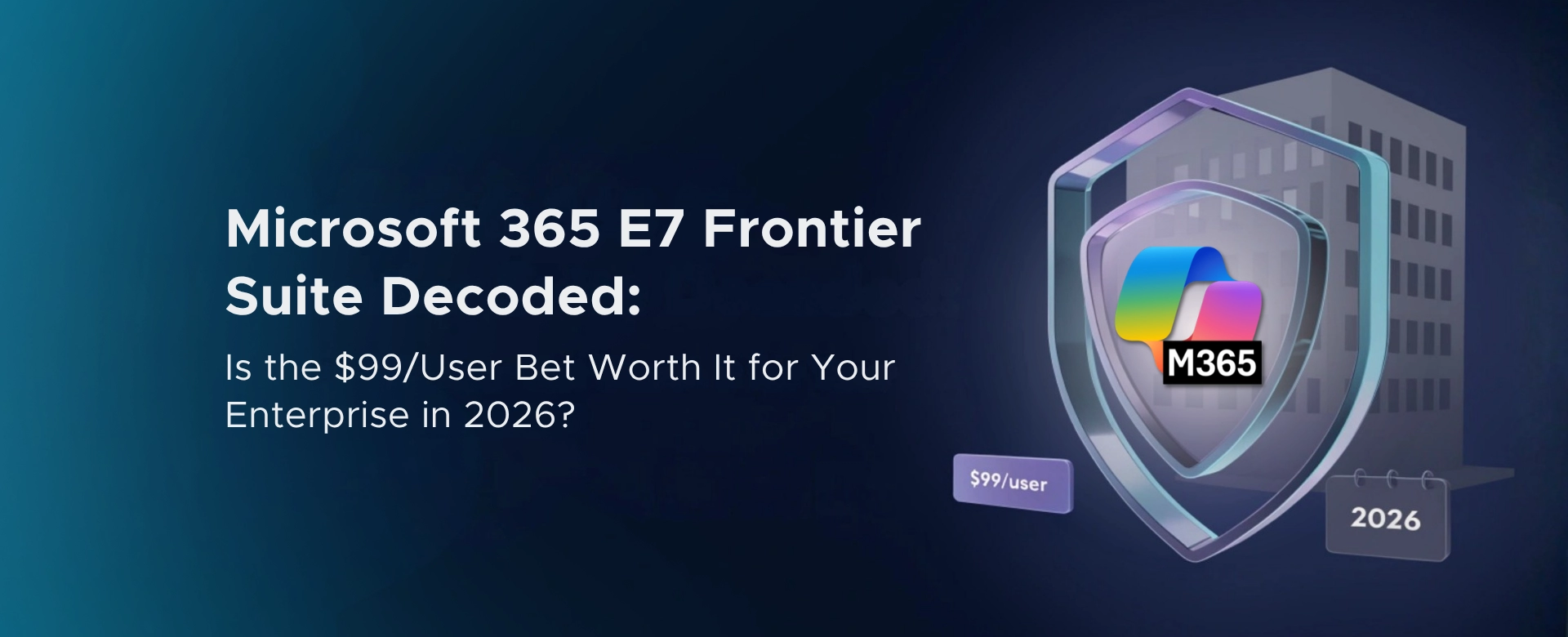
Microsoft just put a price tag on its entire AI vision.
Ninety-nine dollars. Per user. Per month.
That is the new Microsoft 365 E7 Frontier Suite, generally available May 1, 2026.
And for most enterprises, it is now the single biggest AI licensing decision of the year.
E7 is not a new product.
It is a bundle.
It combines four things that already exist:
Individually, these were separate conversations.
Under E7, they become one conversation, with one price, one contract, and one governance surface.
That is the real shift.
Four Microsoft Products, previously sold and governed separately, consolidated into a single enterprise license.
For leadership teams, E7 answers a question that has quietly been slowing Copilot rollouts for the last twelve months.
Who governs the agents?
As organizations move from Copilot as an assistant to Copilot Studio agents running real workflows, three questions become urgent:
Agent 365, bundled inside E7, is built to answer those questions.
For a CIO or CISO trying to scale AI responsibly, that matters more than any productivity demo.
At scale, E7 is a serious commitment.
Ten thousand users at $99 per seat is roughly $12 million per year, before services, change management, or adoption support.
The hesitation is not about capability.
It is about readiness.
Most enterprises are still working through:
E7 does not fix those gaps.
It exposes them faster.
Before committing to E7, leadership should be able to answer four questions clearly.
Copilot and Agent 365 are only as safe as the permissions underneath them.
If SharePoint, OneDrive, and Teams access is overly broad today, E7 will scale that exposure, not contain it.
Data readiness is the first gate.
E7's value depends on meaningful agent adoption.
If the organization has no clear roadmap for which workflows move to agents in the next twelve months, most of the Agent 365 value sits unused.
Licensing should follow a use case plan, not precede it.
Agent 365 provides the control plane.
It does not provide the owner.
Someone in the organization needs to be accountable for agent lifecycle, access policies, and audit reviews. If that role is unclaimed, E7 becomes shelfware with a premium price.
Per-user productivity gains are easy to claim and hard to prove.
Per-agent outcomes, hours saved, cases resolved, documents processed, are what CFOs will eventually ask about.
If that measurement layer is missing, the renewal conversation in 2027 will be uncomfortable.
For some organizations, E7 is the right call today.
It fits best when:
In those environments, E7 simplifies a stack that was becoming hard to govern.
For others, E7 is early.
It is usually a stretch when:
In those cases, the right move is not to skip E7.
It is to prepare for it deliberately, so the investment lands on a foundation strong enough to hold it.
E7 is not a productivity upgrade.
It is a governance commitment dressed as a license.
Organizations that treat it as the former will overpay.
Organizations that treat it as the latter will use it to consolidate AI risk, AI adoption, and AI value into a single, auditable operating model.
The price is $99.
The real cost, and the real return, depend entirely on the readiness underneath it.
If you are a CIO, CTO, CFO, or CISO evaluating the Microsoft 365 E7 Frontier Suite and you are seeing:
it may be time to run a structured E7 readiness assessment before the renewal cycle forces the decision.
I work with organizations to:
Feel free to contact us.
Learn how to prepare your organization for Microsoft 365 Copilot by aligning strategy, cleaning up data, securing access, training users,...
Monthly updates, news & events from Microsoft Copilot to help you & your business grow & get best out the...