Foundry Local Is Here: Run Microsoft AI Models On Premises Without the Cloud
Run Microsoft AI models on-prem with Foundry Local - no cloud, full privacy, lower cost, and offline AI with optimized...


For years, Microsoft’s AI story was simple.
OpenAI models. Azure hosting. Enterprise distribution.
That story has changed.
Microsoft is now shipping first‑party models, and they’re priced aggressively.
The question is not “are they good?” The question is “should your workloads switch?”
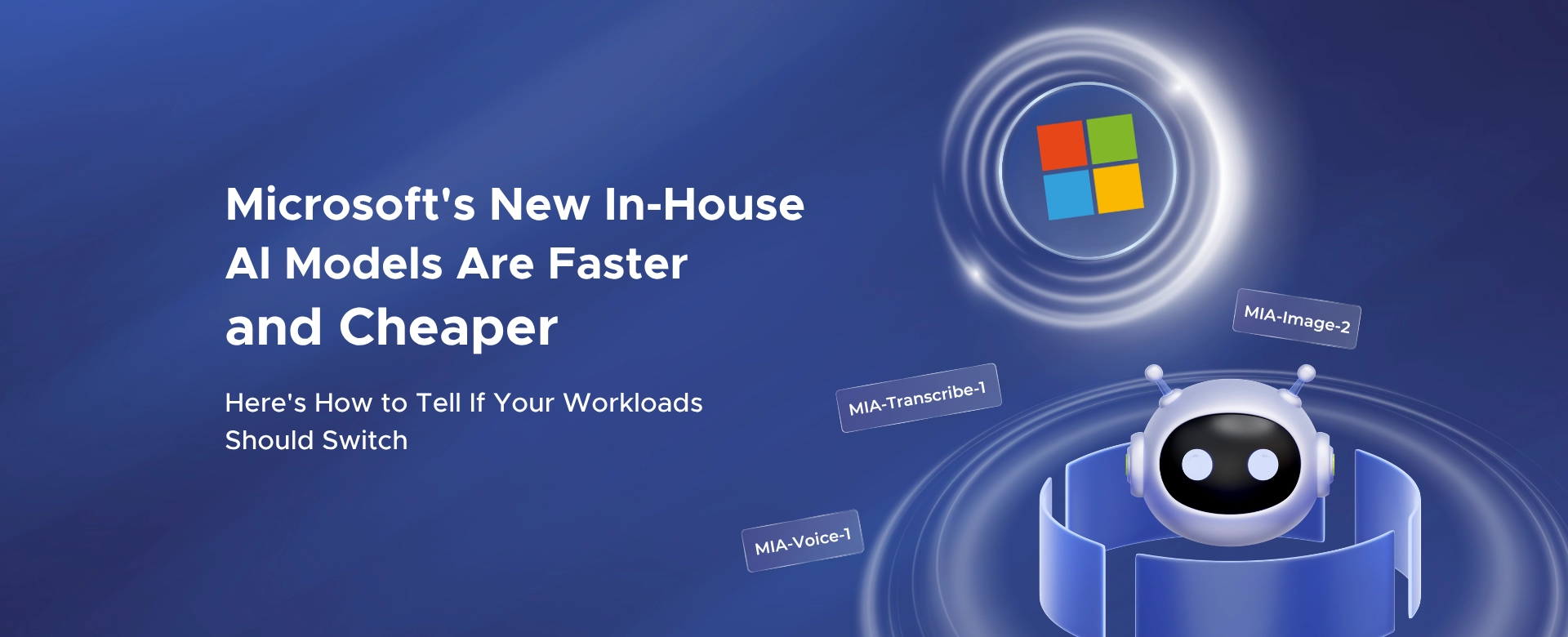
Microsoft shipped three MAI models through Microsoft Foundry.
MAI‑Transcribe‑1 for speech‑to‑text. MAI‑Voice‑1 for text‑to‑speech. MAI‑Image‑2 for text‑to‑image.
Then it shipped MAI‑Image‑2‑Efficient, a cheaper and faster variant built for volume.
At the same time, Phi‑4 is emerging as a serious low‑cost option for many enterprise LLM tasks.
This is Microsoft building its own stack, not just hosting someone else’s.
More details on the model shared by the amazing Naomi Moneypenny here.
If your organization transcribes audio at scale, benchmark this first.
Call centers, meeting recordings, compliance capture, and support QA are all high‑volume pipelines.
High volume is where cost and speed improvements compound quickly.
If you’re using Whisper or another third‑party transcription provider today, MAI‑Transcribe‑1 is worth testing with your own noisy, real‑world audio.
This is not a “nice to have” category. It becomes a budget line item fast.
Voice gets expensive the moment it becomes interactive.
If you’re building voice agents, IVR deflection, real‑time narration, or audio copilots, latency becomes the bottleneck.
MAI‑Voice‑1 is positioned for speed and real‑time generation, not just studio‑quality voice output.
If your current voice experience feels slow, or your voice spend is rising with usage, benchmark it.
Voice is a UX problem first, but at scale it becomes a unit economics problem too.
Most enterprises don’t need one image model. They need two tiers.
One for flagship quality when the output must be perfect. One for throughput when you need volume.
That’s what MAI‑Image‑2 and MAI‑Image‑2‑Efficient are trying to separate.
If your teams generate thousands of images for marketing variants, e‑commerce assets, product mockups, or design iterations, test the Efficient model first.
Most enterprise image workloads are not “one perfect image.” They are “10,000 good images.”
This is where many teams overspend without realizing it.
A huge portion of enterprise LLM usage is not frontier reasoning.
It’s internal classification, summarization, extraction support, policy Q&A, and scoped copilots.
If you are currently using expensive large models for structured internal tasks, Phi‑4 is the first model you should test.
This is where savings show up fast, because token volume is steady and repeatable.
Before migrating anything, answer these four questions clearly.
1. Is the workload high volume? If yes, savings compound quickly; if no, migration might not be worth it.
2. Is this a modality workload? Speech, voice, and image are where MAI is strongest right now.
3. Do you need Azure‑native governance? First‑party models reduce friction for identity, RBAC, and compliance posture.
4. Can you benchmark using your own data? Don’t decide from claims; run your real inputs and measure latency, quality, and cost per unit.
Switching is not automatic.
If your workloads rely heavily on frontier reasoning, long‑context synthesis, or complex multi‑step generation, frontier LLMs may still be the better fit.
If your pipelines are deeply tuned around a model’s behavior, switching introduces regression risk and revalidation cost.
If your usage is low volume, the savings may not justify the migration effort.
MAI models don’t replace everything. They replace specific categories where speed and cost matter most.
Microsoft now offers OpenAI models, MAI models, and Phi models under one platform umbrella.
That’s powerful, but it also forces enterprises to get serious about model selection.
The right move is not “switch everything.” The right move is “switch the workloads where unit economics and throughput matter.”
Keep frontier models for frontier problems.
If you’re evaluating whether to switch transcription workloads, voice agents, image generation pipelines, or high‑volume internal LLM tasks, I’m happy to share a practical benchmarking checklist.
What to test. What to measure. What to validate before migrating.
Feel free to contact us.
Run Microsoft AI models on-prem with Foundry Local - no cloud, full privacy, lower cost, and offline AI with optimized...